
Team: Immunosurveillance of the Central Nervous System http://www.ciml.univ-mrs.fr/science/lab-rejanerua/
immunosurveillance-central-nervous-system.
Group leader: Rejane RUA
Supervisors: Alba Grayston (postdoc) & Rejane Rua (PI)
Address: Centre d’Immunologie Marseille-Luminy, 163 av. Luminy,
13288 Marseille Cedex 9
Mail: grayston-morales@ciml.univ-mrs.fr
Neuroimmunology Internship proposal 2027
For a long time, the brain was considered an « immune-privileged » organ, isolated from the immune system. We now know this picture is far more nuanced. The meninges, the tissue layers enveloping the brain, host a rich immune landscape, including a fascinating population called border-associated macrophages (BAMs), which, unlike microglia patrolling the brain parenchyma, reside at its borders. Far from passive bystanders, BAMs actively communicate with the brain and can influence behaviour and cognition in adult mice, yet the mechanisms underlying this neuroimmune dialogue remain almost entirely unexplored.
BAMs are strategically positioned within meningeal folds that lie in direct proximity to the hippocampus – the brain region at the heart of learning and memory. What makes the hippocampus particularly fascinating is that it is one of the very few regions in the adult brain where neurogenesis continues throughout life: new neurons are continuously born, mature, and integrate into existing circuits, contributing to memory flexibility and resilience.
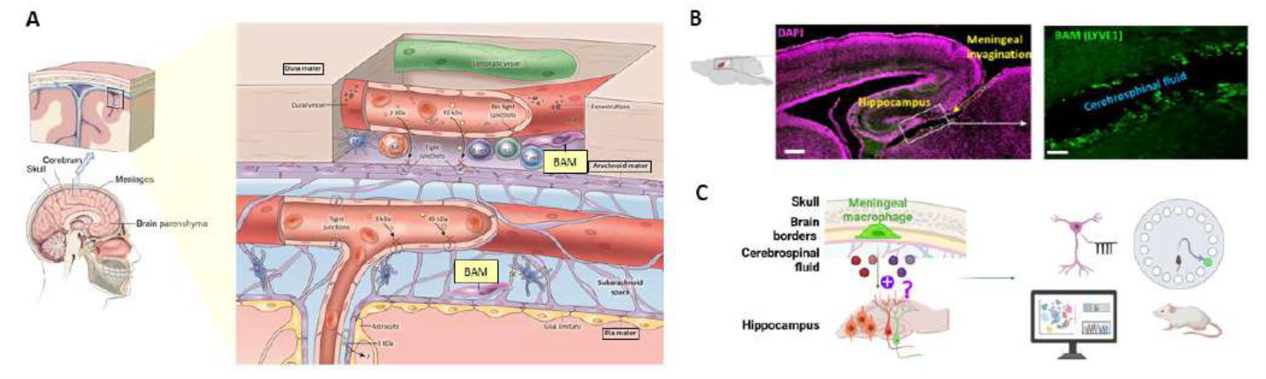
Figure 1. Localization and immune composition of the brain borders. A. The meninges are situated between the surface of the brain parenchyma and the skull. Their outer layer (the dura mater) is particularly enriched in immune cells, including dural meningeal BAM. BAM are also present in the inner meningeal layer. The cerebrospinal fluid flows between the meninges and the brain parenchyma. B. Localization of meningeal BAM (LYVE3+) in the invagination contacting the hippocampus. Scale bar: 200μm (left) and 50μm (right). C. Schematic of the hypothesis regarding the role of BAM in hippocampal function and cognition and examples of experimental approaches (right).
Our preliminary data suggest that BAMs actively support this process. We hypothesize that BAMs nurture hippocampal neurogenesis and neuronal function, and that this communication breaks down during inflammation. The project will explore two complementary questions, during neurodevelopment and in the adult mouse brain:
1. In the healthy brain: what do BAMs do for neurons?
2. During inflammation: do BAMs turn against the brain?
To address these questions, we use state-of-the-art approaches to identify and specifically manipulate the molecular signals released by BAMs, combining innovative pharmacological and genetic mouse models.
This project sits at the exciting interface of neuroimmunology, cell biology, and molecular neuroscience. During your internship, you will have hands-on training in mouse handling and tissue dissection, flow cytometry, immunohistochemistry, confocal microscopy, RT-qPCR, single cell RNA sequencing data analysis and complementary in vitro assays (such as meningeal explant co-cultures with neurospheres). You will also have the opportunity to observe behavioural experiments conducted in the lab, where we use automated video tracking to assess memory, exploration, and locomotion in mice – providing a cognitive readout of the neuroimmune interactions studied at the molecular level.
What are we looking for?
We are looking for a motivated M2 student with:
• A background in neuroscience, immunology, or a related life science
• Curiosity and enthusiasm for neuroimmunology
• Comfort (or willingness to learn) working with mice
• An interest in combining wet lab experiments with data analysis
Prior experience with any of the techniques above is a plus, but not required as training will be provided.
Why join us?
The student will join a young and dynamic team (ERC laureate) consisting of 2 researchers, 2 postdocs, 2 engineers, and 3 PhD students. The Centre d’Immunologie Marseille-Luminy institute (CIML) is a leading immunology institute in France and nestled in a vibrant neuroscience community, located on the Luminy campus, at the entrance of the Parc National des Calanques. This unique campus environment offers the opportunity to develop an interdisciplinary profile at the interface of immunology and neuroscience, with access to state-of-the-art microscopes, cytometers, histology, and genomics facilities across institutes.
Selection of recent publications
Haidar N, Salvon L, Al-Sayyar A, Kassem O, Romano A, Rua R. Physiological effect of cytokines on adult neurogenesis: a focus
on in vivo knock-out studies. Cells Dev (2026)
Eme-Scolan E, Gomes M, Bani A, Romano A, Kassem O, Roussel-Queval A, Casel B, Slimani L, Lawrence T, Rua R. Remodeling of
skull bone channels regulates immune infiltration into the meninges during neuroinflammation. Immunity (2026)
Al-Sayyar A, Salvon L, Haidar N, Schult P, Kassem O, Rua R, Romano A. The meningeal-cerebellar axis: a new perspective on
cerebellar development. Cell Mol Life Sci (2025)
Da Mesquita S, Rua R. Brain border-associated macrophages: common denominators in infection, aging, and Alzheimer’s disease. Trends Immunol (2024)
Eme-Scolan E, Arnaud-Paroutaud L, Haidar N, Roussel-Queval A, Rua R. Meningeal regulation of infections: A double-edged sword. European Journal of Immunology (2023)
Rebejac J, Eme-Scolan E, Arnaud-Paroutaud L, (…), Rua R. Meningeal macrophages protect against viral neuroinfection. Immunity (2022)
Rua R, Pujol N. IL-17: good fear no tears. Nat Immunol comments (2020) Rua R, et al. Infection drives meningeal engraftment by inflammatory monocytes that impairs CNS immunity. Nature Immunology (2019)
Rua R, McGavern DB. Advances in Meningeal Immunity. Cell Press Trends Mol Med (2018)
Kwong B, Rua R, et al. T-bet-dependent NKp46 + innate lymphoid cells regulate the onset of T H 17-induced neuroinflammation. Nature Immunology (2017)